What is 'training for longevity', and how do I start in my 40s or 50s?

Coaching education, not medical advice. Talk to your physician before starting a new exercise program, particularly if you have heart disease, high blood pressure, or have been sedentary for a long time.
What changed about how we think about exercise?
For thirty years the goal of exercise was a number on a scale. That has quietly shifted. The research that matters now asks a different question: what predicts whether you are independent, strong and alive at 80? The answer turns out to be measurable in a gym, and the American College of Sports Medicine put fitness programs for older adults at #2 in its 2026 worldwide trends — ahead of almost everything else — while noting that people in their 50s and 60s avoid anything labeled "senior fitness" and show up for things labeled strength or functional.
Marker one: cardiorespiratory fitness (VO2 max)
VO2 max is how much oxygen your body can use at maximum effort. In a Cleveland Clinic study of 122,007 adults who underwent treadmill testing, with a median 8.4 years of follow-up, the most-fit group had roughly a fifth the mortality risk of the least-fit group. Put the other way: low fitness carried an adjusted hazard ratio of about 5.0 versus elite fitness — larger than smoking (1.41), diabetes (1.40) or coronary artery disease (1.29). And there was no ceiling. Fitter was better all the way up.
Marker two: grip strength
Grip strength is a proxy for whole-body muscle and it is startlingly predictive. In NHANES data covering 9,583 U.S. adults, every 5 kg decrease in average grip strength was associated with a 36% higher risk of death in men and a 49% higher risk in women; the weakest fifth had roughly 2.2 to 2.5 times the mortality risk of the rest. The larger international PURE study found the same direction across continents. Grip is also one of the easiest things on this list to train: heavy carries, rows, and deadlifts without straps.
Marker three: leg strength and the floor test
Leg strength is what keeps you out of a fall, and falls are what end independence. The practical test is unglamorous: can you get off the floor without using your hands, and can you stand up from a chair repeatedly in 30 seconds? Squats, lunges, step-ups and deadlifts build exactly that, and they load the hip and spine — which is the same stimulus that protects bone density. In the LIFTMOR trial, supervised heavy lifting twice a week raised spine bone density 1.6% in postmenopausal women with low bone mass, with no injuries.
How do I train all three in a normal week?
You don't need three programs. A Boom week covers all three by design: Monday and Thursday are legs (leg strength, bone), Tuesday and Friday are pressing and pulling (grip, upper-body strength), Wednesday is conditioning and Saturday is a full-body circuit with rowing, sleds and carries (VO2 max and grip together). Three to four coached sessions plus a couple of walks is the whole prescription. Each class is 45 to 60 minutes and every movement scales.
What if I haven't trained in years?
Then you have the most to gain — the biggest mortality difference in the fitness data is between the bottom group and the next one up, not between good and elite. Moving from "sedentary" to "trains a few times a week" is the largest single health improvement available to most adults in their 40s and 50s. Start light, let a coach set the load, and add weight when the movement is clean. Nothing about this requires you to already be fit.
How do I know it's working?
Test, don't guess. Write down what you lift, how many push-ups you can do, how long you can hold a heavy carry, how fast you cover 1,000 meters on the rower, and how many times you can stand from a chair in 30 seconds. Retest every 8 to 12 weeks. Those numbers moving is the result — the scale is a side effect. If you want the deeper conditioning piece, here's how VO2 max actually gets built.
Where in Utah County do I start?
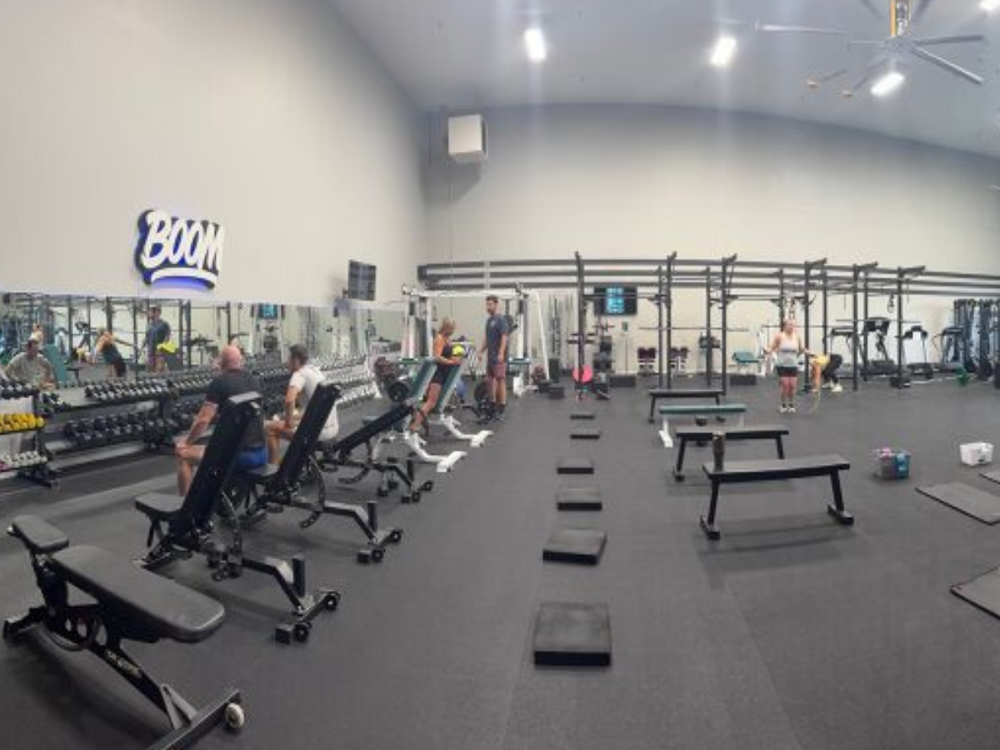
Boom Fitness Culture in Lehi (1657 N State St.) and Pleasant Grove (564 W 700 S Ste. 304): coached strength and conditioning on a real weekly split, nutrition management and coach check-ins included, 24/7 member access, kidcare on weekday mornings (Lehi Mon–Fri 8–10am, Pleasant Grove Tue/Thu/Fri 9–10am), $119.99 a month with no contract. Your first week is free - every class, not one - so you can see the whole week before deciding.
Frequently asked
What does 'training for longevity' actually mean?
Building the three measurable markers that best predict healthy lifespan: cardiorespiratory fitness (VO2 max), grip strength and leg strength - rather than training for a number on the scale.
How much exercise do I need in my 50s?
Two to three coached strength sessions plus one or two conditioning sessions a week covers all three markers. A Boom week is built that way.
Is it too late to start at 50?
No. The largest mortality difference in the fitness research is between the least-fit group and the next one up, so the biggest gains belong to people starting from the least training.
What should I measure?
What you lift, your grip on a heavy carry, a 1,000 m row time, push-ups, and how many times you can stand from a chair in 30 seconds. Retest every 8 to 12 weeks.
Come meet the BOOM family
Your first week is free — every class, either gym, no card. Come as you are and we’ll take care of the rest. We can’t wait to meet you!
Start my free week