How do I improve my VO2 max — and why does it predict more than my weight?

Coaching education, not medical advice. Check with your physician before beginning high-intensity exercise, especially if you have cardiovascular disease, are over 45 and sedentary, or have symptoms with exertion.
What is VO2 max, in plain language?
It's the maximum amount of oxygen your body can take in and use during hard effort. Think of it as the size of your engine. A bigger engine means the same flight of stairs, the same hike, the same day chasing kids costs you a smaller percentage of your capacity — so you're less tired doing the same life.
Why does it predict mortality better than body weight?
Because it measures how well your heart, lungs, blood and muscle actually work together, rather than how much you weigh. The Cleveland Clinic study of 122,007 adults undergoing treadmill testing found an adjusted hazard ratio of about 5.0 for low fitness versus elite fitness. For context, in the same analysis smoking carried 1.41, diabetes 1.40 and coronary artery disease 1.29. Even the step between "below average" and "above average" fitness was worth about as much as not smoking. And unlike most things, the benefit didn't plateau — the fittest group still outlived the next-fittest.
What's the actual formula for building it?
Most of your aerobic work easy, a small amount very hard. In practice, for someone training three to four times a week: two easy sessions of 30 to 45 minutes where you could hold a conversation (this is the "zone 2" everyone is talking about — it's just easy, sustainable effort), and one hard interval session. The interval session that has the most evidence behind it for raising VO2 max is four to six efforts of three to four minutes at a hard but repeatable pace, with equal or slightly shorter rest.
What does that look like at Boom?
Wednesday is the conditioning day — intervals on the rowers, bikes and floor, coached so the pace is right rather than just "as hard as possible." Saturday's full-body circuit with cardio and HYROX-style stations is the long mixed piece: sleds, rowers, wall balls and carries, which builds the engine and grip at the same time. Add one easy walk, jog or bike on your own during the week and you have the full formula. Members have 24/7 access, so the easy session can happen at 9pm.
How do I test it without a lab?
You don't need a metabolic cart. Pick one repeatable test and redo it every 8 to 12 weeks: a 2,000 meter row for time, a 12-minute run for distance, or how long you can hold a set pace on the bike. Same machine, same conditions, same time of day. If the number improves, your engine got bigger. Many modern watches estimate VO2 max too — treat the trend as meaningful and the absolute number as a rough guide.
How fast does it improve?
Faster than most people expect. Meaningful changes show up in eight to twelve weeks of consistent training, and the less fit you are at the start, the bigger the jump. The mistake that stalls people is doing every session at a medium-hard effort — too hard to recover from, not hard enough to drive adaptation. Easy days genuinely easy, hard days genuinely hard.
Does lifting matter for this?
Yes, indirectly and importantly. Stronger legs mean you can push harder on the rower, bike and sled before your muscles quit, so your cardiovascular system gets a better stimulus. Strength also protects the joints that let you keep training for decades. That's why the Boom week is both: strength Monday, Tuesday, Thursday and Friday, conditioning Wednesday and Saturday. If you want the wider picture, this is what training for longevity looks like in your 40s and 50s.
Where can I train this in Utah County?
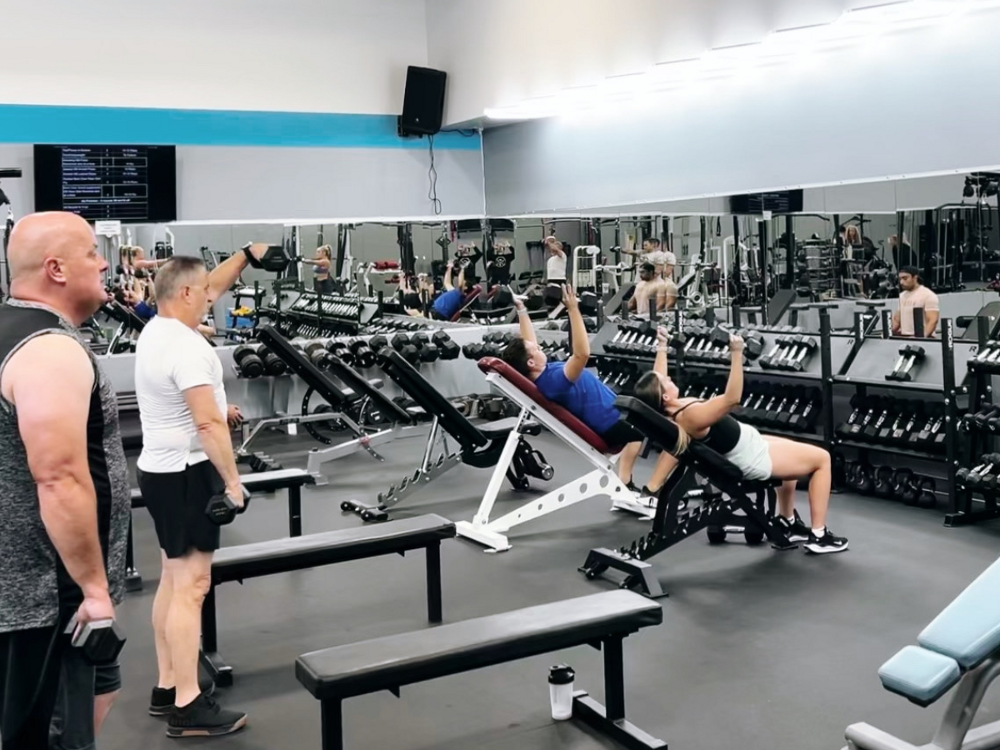
Boom Fitness Culture in Lehi (1657 N State St.) and Pleasant Grove (564 W 700 S Ste. 304): rowers, bikes, sleds, open turf and a coached conditioning block every week. $119.99 a month, no contract, 24/7 access, kidcare on weekday mornings (Lehi Mon–Fri 8–10am, Pleasant Grove Tue/Thu/Fri 9–10am). Your first week is free - come Wednesday and Saturday and you'll have done both halves of the formula.
Frequently asked
What is a good VO2 max?
It depends on age and sex, but the more useful question is whether yours is improving. The research shows benefit continuing all the way up, with no plateau.
How do I raise my VO2 max?
Mostly easy aerobic work you can talk through, plus one hard interval session a week - four to six efforts of three to four minutes with equal rest. Three to four sessions weekly.
How long does it take to improve VO2 max?
Meaningful improvement typically shows in eight to twelve weeks of consistent training, and it comes fastest for people starting from the least fitness.
Can I measure VO2 max without a lab?
Yes - use a repeatable field test like a 2,000 m row, a 12-minute run for distance, or a fixed-pace bike hold, retested every 8 to 12 weeks under the same conditions.
Come meet the BOOM family
Your first week is free — every class, either gym, no card. Come as you are and we’ll take care of the rest. We can’t wait to meet you!
Start my free week